

How to Make Rakhi from Waste Material: 10 Ideas That Won't Cost You a Rupee
Okay, so every year around this time I look at the stuff piled up in my house and think, half of this could actually become a rakhi. Old newspapers, a jar of buttons that nobody remembers where they came from, a couple of bangles that broke months ago and just sat in a drawer since- instead of buying one from the market again, why not just use what's already there.
That's really the whole point behind how to make rakhi from waste material. Not some big sustainability speech, just, we have this stuff, might as well use it instead of it sitting there doing nothing or ending up in the bin.
If you searched for how to make rakhi from waste material because you don't want to spend on new supplies, this is for you. No craft store run required, and once you get the hang of making rakhi from waste materials, you'll probably never buy one from a shop again.
Why create it from waste?
I mean, buying one is obviously easier. Nobody's arguing that. But a rakhi from waste material ends up meaning something the store-bought one doesn't. When your sister ties on something she actually made out of an old newspaper or a broken earring, it's just different.
A few reasons people do this instead of just buying:
You're not spending on stuff you already own. Less plastic and glitter in the trash, which sounds small but adds up over time. No two of these turn out the same. Keeps kids busy for an afternoon, and that's worth something on its own, honestly.
That's basically it. Once you've got a little pile of scrap material collected, actually putting it together doesn't take that long.
Materials you'll need
Go through your house and pull out whatever of this you can find.
Old newspapers or magazines. Cardboard, a cereal box is fine. Broken jewelry, loose beads, spare buttons. Bottle caps, doesn't matter if plastic or metal. Leftover wool from some old knitting thing. Ice cream sticks or matchsticks. Fabric scraps or an old dupatta. Used gift wrap paper. Bangle pieces. A CD that's been scratched and useless for years.
That's most of what a handmade rakhi with waste material actually needs. You probably have half of it right now without even looking, which is kind of the whole point of a handmade rakhi with waste material in the first place.
1. Newspaper bead rakhi
This is what I usually end up doing when I'm running late. Cut newspaper into thin triangle strips, roll them around a toothpick starting from the wide end, glue the tip down so it doesn't unroll. Let them dry, then apply a coat of varnish or clear nail polish for shine. String a few on thread and tie. It looks a lot nicer than "rolled up newspaper" sounds, trust me.
2. Cardboard cutout rakhi
Flatten out a cereal box and cut shapes: circle, heart, whatever you feel like. Add paint or scraps of fabric, and glue thread to the back. That's the whole thing. Easy enough for kids to mostly do on their own, which means either a nice bonding activity or glue everywhere; could go either way.
3. Bottle cap rakhi
Paint the inside of the cap, glue a bead in the middle, punch a small hole near the edge, and loop thread through. Sounds like it shouldn't work, but it looks pretty good, kind of quirky and fun.
4. Wool leftover rakhi
Got wool sitting around from some sweater that never got finished? Wrap it around a small cardboard ring for a pom pom look or just braid a few strands together. Has a warm, soft texture that regular thread doesn't really give you.
5. Broken jewelry rakhi
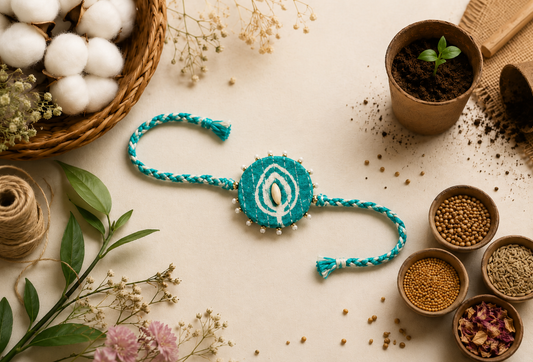
Everyone's got that one drawer. A single earring, a bracelet with a broken clasp, mismatched beads. Glue or thread them onto a base and somehow the finished thing looks more expensive than it actually was. This might genuinely be my favorite handmade rakhi with waste material idea because it rarely looks homemade; it just looks like you picked it out.
6. Fabric scrap flower rakhi
Cut old fabric, worn-out dupatta or tailoring scraps, into small petal shapes, layer them into a flower, and add a bead or button in the center. Soft, colorful, and there's something kind of satisfying about turning fabric that was headed to the bin into a handmade rakhi with waste material that someone's actually going to wear all day. It's one of those handmade rakhi with waste material ideas that looks way harder than it actually is.
7. Ice cream stick rakhi
Clean, dry sticks arranged into a star or fan, glued, painted bright colors. Basically a kids craft project wearing a rakhi costume. Messy but genuinely fun, and the end result is usually better than you'd think.
8. Wrapping paper quilling rakhi
If you've got old gift wrap scraps lying around, cut into thin strips and try quilling, rolling them into tight coils and shaping into flowers or spirals. Takes more patience than everything else on this list. Probably the fanciest looking one here if you actually sit down and do it properly.
9. Bangle piece rakhi
Broken bangles, glass or metal, especially the colorful ones, make a good centerpiece for a handmade rakhi with waste material. Glue a curved piece onto a base, build around it with beads or thread. Has that traditional festive look without buying anything actually traditional.
10. Old CD rakhi
That scratched CD nobody's played in years, cut it into a small shape using strong scissors or a craft cutter. The shiny surface adds something unexpected once you pair it with thread and a bead. Not for everyone, but it definitely gets noticed.
How the whole process actually works
Once you've made a couple of these, you'll notice it's basically the same steps every time.
Clean whatever material you're using first; dust and leftover grease don't help anything. Cut or shape it into your base. Decorate it however fits: beads, paint, sequins- doesn't matter. Attach thread securely at the back. Let it dry properly before you start handling it too much.
That's genuinely the whole thing. Once you know how to make handmade rakhi with waste material this way, it stops feeling like following instructions and just becomes something you know how to do.
Some things I learned by messing it up first
Clean your materials properly and let them dry all the way. Food residue on cardboard or fabric attracts bugs, and finding that out later is not a good time.
A glue gun beats regular glue almost always, especially for anything with weight like bangle pieces or bottle caps.
A bit of varnish or nail polish on paper and cardboard makes it last way longer and gives it a nice shine too.
Keep the final thing light. Glass and metal look nice but get uncomfortable fast if someone's wearing it the whole day.
Mixing two techniques together, cardboard base plus fabric flowers plus a bottle cap accent, usually looks more interesting than sticking with just one idea the whole way through.
Why this is worth doing more than once a year
There's kind of a bigger point buried in here even if it sounds like a stretch. Making a rakhi from waste material gets kids, and adults, honestly, to look at stuff differently. That broken bangle stops being trash and becomes a material you can use. Some schools run competitions now specifically about how to make rakhi from waste material, so clearly this isn't just a random trend. A lot of teachers seem to prefer it over regular craft homework because it quietly teaches kids how to make rakhi from waste material without turning into a lecture about the environment.
And there's the family time part too. Sitting together sorting through old buttons and fabric turns into more of a shared thing than a chore. A shop-bought rakhi doesn't carry any of that. One made from stuff around your own house, tied by hands that actually worked on it, just feels different.
Questions people usually ask
Can a rakhi made from waste material actually look decent? Yeah, more often than you'd expect. Newspaper, fabric scraps, broken jewelry- give it a bit of patience, and these turn into things that look as good as, sometimes better than, whatever's on the shop shelf.
What's the easiest one to start with? Newspaper beads or the cardboard cutouts. Hard to mess those up too badly, and they're forgiving if your first attempt isn't great.
Can kids actually help with a handmade rakhi with waste material? Yes, and usually they like it more than expected. Ice cream stick designs and cardboard cutouts are safe enough for younger kids to handle on their own.
Do you need any actual craft skill? Not really. Cutting, gluing, patience. If you can hold scissors and use a glue gun, you're basically set.
Will it actually last a full day of wear? With decent glue and nothing too heavy, a handmade rakhi with waste material holds up fine. A lot of people end up keeping it afterward instead of throwing it away once the festival's over.
Is it safe on skin that gets irritated easily? Generally yes, most of these use paper, fabric, thread, or wood instead of anything harsh. Just make sure paint or varnish is completely dry before it touches skin.
Can I skip glue entirely for a handmade rakhi with waste material? Yes, a few designs like the wool one rely mostly on knotting and braiding instead of glue, so it's not always necessary.
Conclusion
Before you head to the market next Raksha Bandhan, actually take a minute and look around your house first. That stack of newspapers, the jar of random buttons, the bangle you kept "just in case," it's all sitting there waiting to become something. Once you actually try to make a rakhi from waste material yourself, buying one off a shelf starts feeling like the boring option, honestly.
Pick something off this list, dig through your own version of that junk drawer, and make something this year that actually has a story behind it.
Tags:
Related articles
The Story Behind Every Handmade Rakhi at Ecokari
Jul 24 2026


