
The Story Behind Every Handmade Rakhi at Ecokari
There's a woman in our workshop who can tell you, just by touch, whether a seed is fenugreek or mustard — without even looking. She's been doing this long enough that her fingers know it before her eyes do. That's the kind of detail that never makes it onto a product page, but it's the entire reason a rakhi from Ecokari looks the way it does.
We didn't start out trying to build an "eco-friendly" brand. We started because a few women had a skill nobody was paying them properly for, and a pile of fabric scraps nobody wanted. This is the story of what happened when we put the two together.
It Starts With a Woman, Not a Machine
Before a rakhi becomes a rakhi, it's just raw material sitting in front of someone — thread, fabric scraps, a needle. One of our artisans sits with it and starts working, and there's no machine involved anywhere in that process. Our handmade rakhi collection is built entirely by women artisans, many of whom learned embroidery and knotting from their mothers or grandmothers long before Ecokari came into the picture.
You can actually tell the difference once you hold one. The stitch isn't perfectly even. Two rakhis from the same batch won't look exactly alike. That used to bother people when we first started — "why doesn't this look identical to the sample photo?" — but that's kind of the whole point. A machine-made rakhi is consistent because nobody touched it. Ours are a little inconsistent because a real person did.
There's also a simpler reason this matters to us. Every rakhi sold is income for the woman who made it. Not a donation, not charity — actual paid work for actual skill. When you tie one on your brother's wrist, somewhere a woman got paid for the hours she put into it. That's not a tagline, that's literally how the business runs.
We Use What Other People Throw Away
Here's a part people don't usually expect. A chunk of our rakhis are made from things that would've ended up in the trash otherwise — leftover fabric scraps, cotton swabs, offcuts from other production runs. We didn't set out with some grand plan to build a "zero waste" brand. It started because fabric waste was sitting around, and someone figured out it could be turned into something else instead of getting binned.
The textile industry throws away an enormous amount of material every day — small offcuts, thread ends, extra cloth nobody needed. Most of it just goes to landfill because sorting and reusing it takes more effort than most factories are willing to put in. Our artisans do that sorting by hand. A scrap that would've been garbage becomes the base of a rakhi instead.
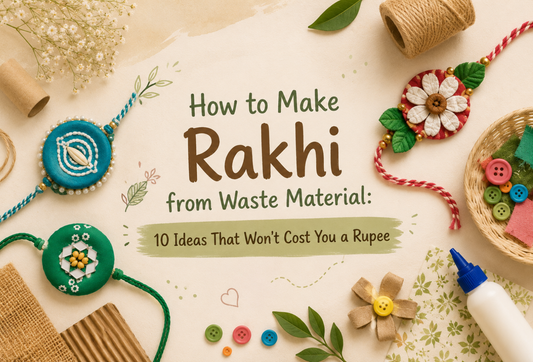
So when we say rakhi from waste material, it's not a marketing phrase we came up with after the fact. It's genuinely what a good chunk of the process looks like — someone picking through fabric that was headed for the trash and deciding it still had something left to give.
The Rakhi You Don't Have to Throw Away
Most rakhis have a pretty short life. You tie it in the morning, wear it for a few weeks, and then one day you just take it off and toss it without really thinking about it. Nobody feels bad doing that — it's just what you do with a rakhi. But it always felt a little off to us that something meant to symbolise a lifelong bond gets binned within a month.
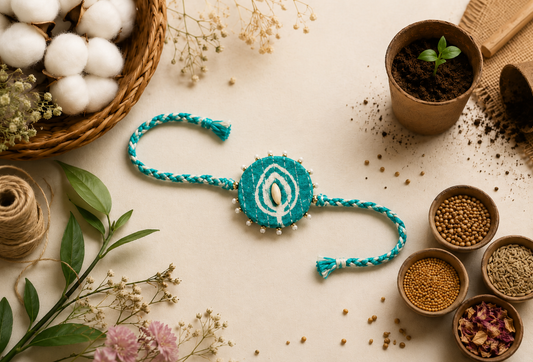
So we make plantable rakhi — rakhis with actual seeds worked into the thread or fabric. Mustard, fenugreek, things like that. Once you're done wearing it, instead of throwing it in the bin, you plant it. Give it some water, some sun, and in a week or two you've got a little seedling coming up where a rakhi used to be.
It's a small thing, but it changes what the object means a little. A sibling relationship isn't supposed to end after one day either — it's supposed to keep going, keep growing, long after Raksha Bandhan is over. A rakhi that turns into a plant just happens to say that a bit more literally than most.
Fabric Rakhis That Don't Have To End Up in a Drawer
Not everything we make is meant to go into the soil, though. Some of our rakhis are made from hemp or cotton fabric, hand-embroidered, and built sturdy enough to survive more than a few weeks on a wrist. Once Raksha Bandhan is done, a lot of people just clip these onto a keyring instead of putting them away in a drawer somewhere.
It wasn't something we advertised loudly at first — it just started happening because the fabric held up well and people didn't want to get rid of something that took someone hours to embroider. Now it's basically part of how we design them. The same rakhi that sat on your brother's wrist in August is still hanging off your bag in December.
Why Bother Doing It This Way
Honestly, it would be a lot easier to just order plastic rakhis in bulk from a supplier and sell those. Cheaper, faster, no dependency on how many artisans are available that week. We know that. But that's not really why we started this.
A handmade rakhi takes longer to make and costs more to produce, but it means an actual woman gets paid fairly for actual skilled work. A rakhi made from waste fabric takes more sorting and more patience than buying fresh material, but it means less of it ends up in a landfill. And an eco-friendly rakhi that can be planted or reused doesn't disappear the week after the festival — it sticks around, one way or another.
None of this is complicated. We just decided that a thread meant to represent something as personal as a sibling bond shouldn't be the most disposable, forgettable part of the whole festival.
The Women Behind It
It's easy to say "women artisans" like it's one thing, but it isn't. Some of the women we work with are mothers embroidering between chores. Some are younger women picking up a craft their grandmothers used to do, mostly out of curiosity at first, and then getting genuinely good at it. A few started just stitching small pieces and now design entire collections on their own.
For a lot of them, this work means more than the money, though the money obviously matters too. It's one of the few things in their day that's entirely theirs — their skill, their pace, their design choices. We're not claiming to have single-handedly changed anyone's life. We just try to give consistent work and pay fairly for it, and let the craft speak for itself.
A Small Choice That Adds Up
It's easy to think one rakhi doesn't matter much either way. And on its own, it probably doesn't. But Raksha Bandhan generates a genuinely surprising amount of waste every year across the country — plastic packaging, synthetic thread, decorations that get thrown out within days. Multiply that by a few million households, and it stops looking small.
Picking a handmade rakhi or a plantable rakhi instead of a plastic one doesn't fix that problem by itself. But it's one less rakhi in a landfill, one more day of paid work for someone who needs it, and honestly, it just feels better on the wrist too.
More Than Just a Thread
At the end of the day, a rakhi is meant to represent something that lasts — a bond that doesn't expire. We just thought the object itself shouldn't expire so fast either.
So this Raksha Bandhan, before you pick up whatever's closest at the shop, it's worth asking what you actually want to tie onto your brother's wrist. Something that ends up in a bin in three weeks? Or something a woman spent real time making, built from material that almost got thrown away, designed to keep existing — as a plant in your garden, or a keychain in your bag, long after the knot comes off.
Tags:
Previous
Handmade Paper Diary: A Timeless Blend of Craft, Sustainability, and Creativity
Next
How to Make a Plantable Rakhi at Home (And Actually Make It Grow)